miercuri, 25 martie 2009

Knowing Lithuania/ Cunoscand Lituania

Lithuania is a baltic country from Northern Europe. The West boorder is the Baltic Sea. In the Norht it is bordered by Letony, in South-East with Belarus. In South with Poland, and in Souht- West with Russia by its Kalinigrad enclave. It has a lenght of the shore of 99km and a surface of 65,3 mil square km.
Lithuania has a mostly field relief, alongside the seaside and in the centre, and in the rest it is made of morainic hills, the entire territory of the country being shaped by the cuaternar ice calotte. The climate is temperate with maritimal influences. The main river is called Nemunas(Neman), also having almost 3000 lakes most of them being of ice origin. The forests, most of them coniferous take over 30%of the surface of the country.
The population of the country is of 3.5 mil inhabitans having a density of 55.2 inhabitants/square km. The capital city is Vilnius and the main towns are Kaunas, Klaipeda,Siauliai.
Lithuania has entered the European history when it was firstly mentioned in a medieval German manuscript, the Quedlinburg Chronicle on February, 14th, 1009. The Lithuanian territories were united by Mindaugas in 1236, his official coronation as King of Lithuania taking place on July, 6th, 1253. In Gediminas’ early years territories that are now part of Belarus, Ukrainne, Russia and Poland were taken over. At the end of the 14th century, Lithuania was the biggest country from Europe. The independence of the state was declared on February, 16th, 1918 and acknowledged on July, 12th 1920. In 1940 it looses its independence being incorporated in URSS but it takes it back on March, 11th. 1990 and reacknowledged on fenruary, 9th, 1991. From 2004, Lithuania became a country member in NATO and a member of the European Union.

Lituania este o
ţară baltică în Europa de Nord. Graniţa de vest a ţării o constituie Marea Baltică. În nord se învecinează cu Letonia, în sud-est cu Belarus, în sud cu Polonia iar în sud-vest cu Rusia prin enclava sa Kaliningrad. Are o lungime a ţărmului de 99 km şi o suprafaţă de 65,3 mil km2 .
Lituania are un relief predominant de câmpie, în lungul litoralului şi în centru, iar în rest este format din coline morenaice, întreg teritoriul ţării a fost modelat de calota glaciară cuaternară. Clima este temperată cu nuanţe maritime. Principalul râu se numeşte Nemunas (Neman), fiind cca. 3000 de lacuri majoritatea de origine glaciară. Pădurile, predominant de conifere, ocupa aproximativ 30% din suprafaţa ţării.
Populaţia ţării este de 3,5 mil locuitori, având o densitate a populaţiei de 55,2 loc/km2. Capitala ţării este
Vilnius, iar principalele oraşe sunt: Kaunas, Klaipeda, Siauliai. Lituania a intrat in istoria europeană când pentru prima dată a fost menţionată într-un manuscris medieval german, cronica Quedlinburg din 14 februarie 1009. Pământurile Lituaniei au fost unite de Mindaugas în 1236, încoronarea oficială a lui Mindaugas ca rege al Lituaniei având loc în 6 iulie 1253. În perioada timpurie a lui Gediminas au fost ocupate teritorii care astăzi fac parte din Belarus Ucraina, Rusia şi Polonia. La sfârşitul secolului al XIV-lea, Lituania era cea mai mare ţară din Europa. Independenţa statului este declarată la 16 februarie 1918 recunoscută în 12 iulie 1920. În anul 1940 pierde independenţa fiind înglobată în URSS, dar o redobândeşte în 11 martie 1990 şi recunoscută la 9 februarie 1991. Din anul 2004 Lituania devine stat membru NATO şi membru al Uniunii Europene.


Personalities/ Personalitati

Writers/Sciitori:

Balys Sruoga (1896-1947) was an appreciated Lithuanian poet, critic and playwright. In his youth he colaborated with a series of cultural magazines. His works have been published under the liberal wing of the Lithuanian cultural movement and in some newspapers. In 1914 he started to study literature at Sankt Petersburg, in Russia and later in Moscow. In 1921 he joined the University of Munchen where he took his master’s degree in Lithuanian folklore (1924). After returning in the country, Sruoga taught athe the University from Lithuania where he initiated a theatre seminar. He also wrote many articles about literature. In 1930 he began to write drama, firstly Milžino paunksmė and later Radvila Perkūnas, Baisioji naktis and Aitvaras teisėjas. In 1939 he started teaching at the university from Vilnius.


Balys Sruoga (1896 - 1947) a fost un apreciat poet, critic, dramaturg lituanian. În tinereţe a colaborat cu o serie de reviste culturale. Lucrările sale au fost publicate de aripa liberală a mişcării culturale lituaniene şi în unele ziare. În 1914 a început să studieze literatura la Sankt Petersburg, în Rusia şi mai târziu la Moscova. În 1921 s-a înscris la Universitatea din Munchen, unde a obţinut doctoratul în folclor lituanian (1924). După revenirea în ţară, Sruoga predat la Universitatea din Lituania, unde a iniţiat un seminar de teatru. De asemenea, el a scris mai multe articole despre literatură. Din 1930 a început să scrie dramă, în primul rând Milžino paunksmė, mai târziu Radvila Perkūnas, Baisioji naktis şi Aitvaras teisėjas. În 1939 a început să predea la Universitatea din Vilnius.


Composers/Compozitori:

Šatrijos Ragana - Marija Pečkauskaitė (1877-1930) was a Lithuanian writer. She founded the Židikai school. Her most famous works are Sename dvare and Irkos tragedija.
Šatrijos Ragana - Marija Pečkauskaitė (1877-1930) a fost o scriitoare lituaniană. Ea a fondat scoala Židikai. Cele mai faimoase lucrări au fost Sename dvare şi Irkos tragedija.

Mikalojus Konstantinas Čiurlionis (1875 - 1911) was a painter and composer, probaly the most known Lithuanian artist of all times. He contributed to the symbolism and Art Nouveau and and he was one of the respresentants of the period called “fin de siècle”. In his short life he compsed almost 250 musical pieces and he created almost 300 paintings. Most of his works are hosted by the National Museum of Art MK Čiurlionis from Kaunas, Lithuania. His works had a powerful influence over the modern Lithuanian culture. The asteroid 2420 Čiurlionis is named after him.

Mikalojus Konstantinas Čiurlionis (1875 - 1911) a fost pictor şi compozitor, probabil, cel mai renumit artist lituanian al tuturor timpurilor. Čiurlionis a contribuit la simbolism şi Art Nouveau si a fost reprezentant epocii “fin de siècle”. În timpul scurtei sale vieţi a compus aproximativ 250 de piese de muzică şi a creat aproximativ 300 de tablouri. Cea mai mare parte din picturile lui sunt adăpostite în Muzeul National de Arta MK Čiurlionis din Kaunas, Lituania. Lucrarile sale au avut o profundă influenţă asupra culturii moderne lituaniene. Asteroidul 2420 Čiurlionis este numit dupa el.


Juozas Gruodis (1984-1948) was a famous Lithuanian musician, composer, conductor and teacher.
Juozas Gruodis (1984-1948) a fost un renumit muzician lituanian, compozitor, dirijor, profesor.


The Artists/Artişti:

Antanas Žmuidzinavičius (1976-1966) was a famous Lithuanian paintor and a well known arr collectioner. Sometimes he used Antanas Žemaitis as nickname. From 1899 he studied at different European universities. Later, Žmuidzinavičius gave speaches about Lithuania. Togehter with M.K. Čiurlionis and other Lithuanians he organised the first art exhibition at The House of Petras Vileišis. Between 1926 and 1940 he taught frawing at Kaunas and in 1947 he became teacher. Amongst his most famous works are Gavo laišką (1904), Paskutiniai spinduliai (1908), Estijos peizažas (1929). Antanas Žmuidzinavičius died in 1966 and was buried in the Petrašiūnai Cementery, Kaunas. The Žmuidzinavičius Museum was established in his former house.

Antanas Žmuidzinavičius (1976-1966) a fost un pictor lituanian şi un cunoscut colecţionar de artă. Uneori el a folosit Antanas Žemaitis ca pseudonim. Din 1899 a studiat la diferite universităţi europene. Mai târziu Žmuidzinavičius emis prelegeri despre Lituania. Împreună cu M.K. Čiurlionis şi alţi lituanieni a organizat prima expoziţie de artă la Casa Petras Vileišis. Între 1926 şi 1940 a predat desen în Kaunas, şi în 1947 a devenit profesor. Printre cele mai faimoase picturi sale sunt Gavo laišką (1904), Paskutiniai spinduliai (1908), Estijos peizažas (1929). Antanas Žmuidzinavičius a murit în 1966 şi a fost înmormântat în Cimitirul Petrašiūnai, Kaunas. Muzeul Žmuidzinavičius a fost stabilit în fosta sa casă.


Sportives/Sportivi:

Šarūnas Jasikevičius, born on march 5th, 1976 in Kaunas, Lithuania is a Lithuanian professional basketball player. At present, he plays for Panathinaikos in Greece as well as for the national basketball team of Lithuania.
Šarūnas Jasikevičius, născut la 5 martie 1976 în Kaunas, Lituania este un jucător lituanian profesionist de baschet. El în prezent joaca pentru Panathinaikos, în Grecia, precum şi la echipa naţională de baschet a Lituaniei.


Virgilijus Alekna born on February 13th, 1972 in Terpeikiai, near Kupiškis is a famous Lithuanian athlete. He won two gold medals at the Summer Olympic Games in Sidney (2000) and in Athens (2004) and in Beijing he got the bronze medal. He was also world champion and European champion as well in throwing the disk. In 2007 he was appointed UNESCO Champion for sport.
Virgilijus Alekna, născut la 13 februarie 1972 în Terpeikiai, lângă Kupiškis este un atlet lituanian renumit. El a câştigat două medalii de aur la Jocurile Olimpice de Vară de la Sidney (2000) şi Atena (2004), iar la Beijing a obţinut bronz. A fost de asemenea campion mondial şi european la aruncarea discului. În 2007 el a fost numit Campion UNESCO pentru sport.


duminică, 8 martie 2009

For all the mothers around the world

Mother’s Day
By Raluca Trifan


Thank you

Dear mom,
I'd like to say thank you,
I'm a little bigger now
And I understand what you,
Did for me to be somehow.
To grow old, to be healthy, to know...

I linger in the doorway,
Waiting for your signal
That I can step into the room.
‘cause you'd rather sacrifice yourself,
For me to be in...safe.

Dear mom,
You gave me life, you understood my needs
Even when I couldn't speak
You taught me 'Life's how it should be'
You taught me 'I will always pay that fee'.


Mother
By Corina Paun


Tell your children not to walk my way
tell your children not to hear my words
What they say
what they mean
Mother,
Can you hide them from the waiting world,
Can you keep them in the dark for life?

If by chance I pass before you
Don't discount my gratitude,
You're responsible for me here…
And of course my attitude!

Raise the roof
Mother dear I'm returning tonight,
Light the lite
Now I see
Your concern,
Mother dear how you taught me to learn!

Staying up half the night
Wonderin' if what I'm doin' is right,
Raise the roof,
Light the lite,
Mother dear I'm returning tonight!

sâmbătă, 21 februarie 2009

Painters

CONSTANTIN BRANCUSI


Born in Romania, Constantin Brancusi first studied sculpture at the School of Arts and Crafts in Craiova (1894–98) and the National School of Fine Arts in Bucharest (1898–1902). In 1904, he left Romania permanently, traveling through Budapest, Vienna, Munich, Zurich, and Basel on his way to Paris. There, he continued his training at the École des Beaux-Arts (1905–7), and his work of the period attracted the attention of the French sculptor Auguste Rodin. About 1907, Brancusi began to work by direct carving as a means of distancing himself from Rodin's style. In Paris, Brancusi associated with many artists of the day, including Henri Rousseau, Henri Matisse, Fernand Léger, Amedeo Modigliani, and Marcel Duchamp. He showed five of his sculptures in the 1913 Armory Show in New York, and continued to exhibit widely throughout his life.From the 1920s to the '40s, Brancusi was preoccupied by the theme of a bird in flight. He concentrated not on the physical attributes of the bird but on its movement.
Nascut in Romania, Constantin Brancusi a studiat mai intai sculptura la Scoala de Arte si Meserii din Craiova (1894–98) si Scoala nationala de arta fina din Bucuresti (1898–1902). In 1904 el a plecat definitiv din Romania calatorind prin Budapesta,Viena,Munich, Zurich, si Basel in drumul sau spre to Paris. Acolo, si-a continuat pregatirea la Scoala de arte frumoase (1905–7), iar munca sa din acea perioada a atras atentia sculporului francez Auguste Rodin. In jurul anului 1907, Brancusi a inceput sa sculpteze direct distamtadu-se astfel de stilul lui Rodin. In Paris, Brancusi s-a asociat cu multi dintre artistii vremii, inclusiv Henri Rousseau, Henri Matisse, Fernand Léger, Amedeo Modigliani si Marcel Duchamp. Si-a expus cinci dintre sculpturile sale in Spectacolul Armory din 1913 din New York si a continuat sa expuna mult pe parcursul vietii. Din anii 1920 pana in anii 40, Brancusi a fost preocupat cu tema pasarii in zbor. El s-a concentrat nu pe atributele fizice ale pasarii ci pe ale miscarii sale.
The Endless Column – 1937
It is Brancusi’s masterpiece, seen by Ionel Jianu as a synthesis of his life time career... and by Barbu Brezianu as the essence of his work, being one of the most admired sculptures of the century.
Coloana infinitului-1937
Este capodopera lui Brancusi, vazuta de ionel Jianu ca o sinteza a carierei sale de-a lungul vietii... si de Barbu Brezianu ca esenta municii sale, fiind una dintre cele mai admirate sculputi ale secolului.

THE TABLE OF SILENCE
The table suggests the harsh appearance of two windmill stones laid one above the other.
The sculptor used to say ...the line of The Table of Silence suggests the closed curbure of the circle which gets together, gets closer and unites.

MASA TACERI - Masa sugereaza aparitia dura a doua pietre de moara puse una peste alta. Sculptorul obisnuia sa spuna...linia Meseii Tacerii sugereaza curbura apropiata a cercului care se apropie pana se uneste.


THE GATE OF THE KISS
In the gate from Targu Jiu also known as The Gate of the Kiss, the embracing of the two bodies , as two halves of the same seed forms the perfect shape of a circle. Through the circle shaped sculpture, the Sun is being called invoking in this way its magical and natural power.
Poarta Sarutului - Poarta de la Targu Jiu cunoscuta ca si Poarta Sarutului, imbratisarea a doua corpuri, ca doua jumatati ale aceleiasi seminte, formeaza forma perfecta a unui cerc. Prin sculptura in forma de cerc soarele este chemat invocandu-i drumul spre puterea magica si naturala.

BIRD IN SPACE
From the 1920s to the '40s, Brancusi was preoccupied by the theme of a bird in flight. He concentrated not on the physical attributes of the bird but on its movement. In Bird in Space, wings and feathers are eliminated, the swell of the body is elongated, and the head and beak are reduced to a slanted oval plane. Balanced on a slender conical footing, the figure's upward thrust is unfettered. Brancusi's inspired abstraction realizes his stated intent to capture "the essence of flight."

Pasarea in spatiu- Din anii 1920 pana in anii 40 Brancusi a fost preocupat cu tema pasarii in zbor. El s-a concentrat nu pa atributle fizce ale pasarii ci pe miscarea ei. In Pasare in Spatiu, aripile si penele sunt eliminate, forma corpului este prelungita iar capul si ciocul sunt reduse la un plan oval minim. Balansata pe un piedestral conic,forma ridicata este lipsita de aripi. Abstractizarea inspirata a lui Brancusi a atins intentia lui de a captura „esenta zborului”

---------------------------------------------------------------------------------------
NICOLAE GRIGORESCU

He was born in Pitaru, (judeţul Dâmboviţa), Romania. At a young age (between 1848 and 1850), he became an apprentice at the workshop of the painter Anton Chladek and created icons for the church of Băicoi and the monastery of Căldăruşani. In 1856 he created the historical composition Mihai scăpând stindardul (Michael the Brave dropping the flag), which he presented to the Wallachian Prince Barbu Ştirbei, together with a petition asking for financial aid for his studies.
Between 1856 and 1857, he painted the church of the
Zamfira monastery, Prahova County, and in 1861 the church of the Agapia monastery. With the help of Mihail Kogălniceanu, he received a scholarship to study in France.
In the autumn of 1861, young Grigorescu left for
Paris, where he studied at the École des Beaux-Arts. He also attended the workshop of Sébastien Cornu, where he had as a colleague Pierre-Auguste Renoir. Knowing his weaknesses, he concentrated drawing and composition. However, he soon left this workshop and, attracted by the artistic concepts of the Barbizon school, he left Paris for that village, where he became the associate of artists such as Jean-François Millet, Jean-Baptiste Camille Corot, Gustave Courbet and Théodore Rousseau. Under the influence of the movement, Grigorescu looked for new means of expression and followed the trend of en plein air painting, which was also important in Impressionism. As part of the Universal Exposition of Paris (1867), he contributed seven works. Then he exhibited at the Paris Salon of 1868 the painting Tânără ţigancă (Gypsy girl).
He returned to Romania a few times and starting in 1870 he participated in the exhibits of living artists and those organized by the Society of the Friends of the Belle-Arts. Between 1873 and 1874 he traveled to
Italy, Greece and Vienna.
In 1877 he was called to accompany the
Romanian Army as a "frontline painter" in the Romanian War of Independence. During the battles at the Grivica Strongpoint and Oryahovo, he made drawings and sketches which later used in creating larger-scale works.
In 1889 his work was featured in the
Universal Exhibition in Paris and at the Romanian Atheneum. Centerpiece exhibits took place at the Romanian Atheneum would follow in 1891, 1895, 1897, 1902, and 1905.From 1879 to 1890 he worked in France, especially in Vitré, Bretagne, and in his workshop in Paris.

Nascut in Pitaru (judetul Dambovita). La o vartsa mica (intre 1848 si 1850), a devenit ucenic in atelierul pictorului Anton Chladek si a creat icoane pentru biserica din Băicoi si manastirea Căldăruşani. In 1856 el a creat istorica compozitie Mihai scăpând stindardul, pe care a prezentat-o printului valah Barbu Ştirbei,impreuna cu o petitie cerand ajutor financiar pentru studiile sale. Intre 1856 si 1857, a pictat biserica manastirii Zamfira, judetul Prahova , si in 1861 biserica manastirii Agapia . cu ajutorul lui Mihail Kogălniceanu,el a primit bursa pentru a studia in Franta. In toamna anului 1861,tanarul Grigorescu a plecat la Paris, unde a studiat la Scoala de Arte Frumoase. Deasemenea, el a urmat atelierul lui Sébastien Cornu, unde l-a avut drept coleg pe Pierre-Auguste Renoir. Cunoscandu-si slabiciunea, el s-a concentrat pe desen si compozitie. Totusi, in curand a plecat de la atelier, si atras, de conceptele artistice ale scolii lui Barbizon, a plecat din Paris catre acel satunde a deveni asociatul unor artisti precum Jean-François Millet, Jean-Baptiste Camille Corot, Gustave Courbet si Théodore Rousseau. Sub influenta miscarii, Grigorescu a cautat noi modalitati de expresie si a urmat curentul picturii en plein air care a fost important in Impresionism. Ca parte a expozitiei universale de la Paris,(1867), el a contribuit cu sapte lucrari. Apoi a expus la Salonul din Parisi in 1868 tabloul Tânără ţigancă . S-a intors in Romania de cateva ori si incepand cu 1870 a participat la cateva expozitii ale artistilor in viata si a celor organizate de Societatea Preitenilor Artelor Frumoase. Intre1873 si 1874 a calatorit in Italia, Greci si Viena. In 1877 a fost chemat sa insoteasca armata romana ca “pictor de frontiera” in Razboilu Roman de Independenta. In timpul bataliilor la Grivita si Oryahovo, a facut desene si schite pe care le-a folosit ulteriro pentru a crea operele la scara mare.
In 1889 operele sale au aparut in Expozitia Universala din Paris si la Ateneul Roman, Expozitii cu capodoperele sale au urmat la ateneul Roman in anii 1891, 1895, 1897, 1902, si 1905.
Din 1879 pana in 1890 el a lucrat in Franta, in special in
Vitré, Bretania, si in atelierul sau din Paris.


Fisherwoman at Grandville


Oxen Cart


Peasant Woman Head


------------------------------------------------------------------------

THEODOR AMAN

The Romanian painter who after taking drawing lessons with Constantin Lecca painter, at the Central School from Craiova, goes, in 1850, to Paris, where he studies painting with Michel Martin Drolling, next, from 1851, with Francois Edouard Picot. This time he starts a historical compositions series, one of his favorites genre, in which he excels, creating a school (Last night of Mihai Viteazul, 1852; Battle from Oltenita, 1857; Battle from Alma, 1855; Union of the Principates, 1859; Romanian battle with the turks in St. George Island, 1859; Vlad Tepes and the messengers, 1861-1864; Turks driving away at Calugareni, 1872; Tudor Vladimirescu, 1874-1876; Boyards catched at dinner by Vald Tepes messengers, 1885-1887). The prestige he gained was encreased by being manager of the Fine Arts National School, since the creation of this institutions, in 1863. In his rigorous painting, the evocation symbols bring a certain freshness, in the sense of the artist situation in reality. The novelty of his paintings are responses to his social and political cares in the period of the national state formation. There are also tries to enlighten the palette, by instantaneous snapshots, which speak to us about the echo, being even pale, of his experiences with some french artist which painted outdoor, at Barbizon, near Paris, where in the 7th and 8th decades, the basis of impressionism are layed out (View with the boat on the lake; Street in Sinaia; Constanta Harbour; Family Reunion; Gunboat in Constanta Harbour; In Park etc.)

Pictorul roman care dupa ce a luat lectii de desen cu pictorul Constantin Lecca , la Scoala Centrala din Craiova, merge, in 1850, la Paris,unde studiaza pictura cu Michel Martin Drolling, apoi, din 1851, cu Francois Edouard Picot. De aceasta data incepe o serie de compozitii istorice, genul sa preferat, in care exceleaza creeind o scoala.(Utlima nopate a lui Mihai Viteazul852; Batalia de laOltenita, 1857; Batalia de la Alma, 1855; Unrea Principatelor, 1859; Batalia romanilor cu turciipe insula Sf. George , 1859; Vlad Tepes si solii, 1861-1864; Turcii retragandu-se de lat Calugareni, 1872; Tudor Vladimirescu, 1874-1876; Prestigiul castigat a fost marit prin faptul ca a ocupat postul de director al Scolii Nationale de Arte Fine, de la infiintarea acestei institutii in 1863. In pictura sa riguroasa, simbolurile evocarii aduc o anumita prospetime in sensul situatiei reale a artistului. Noutatea picturilor sale consta in raspunsurile pe care el le avea pentru grijile sociale si politice din perioada fomrarii statului national. Deasemene, el incearca sa lumineze paleta prin instantanee care vorbesc despre ecoul, chiar daca palid, al experientelor cu cativa artisti francezi cu care a pictat in exterior la Barbizon, aproape de Paris. Unde in secolele VII-VIII au fost stabilite bazele Impresionismului (Vedere cu barca pe lac, Strada in Sinaia,Portul Constanta, Reuniunea de familie, Barca in portul Constanta, In parc).


Looking in the album


Dance


Vase of Flowers

Sports

Nadia Comaneci

Born on November, 12th, 1961(Onesti, Bacau), Nadia Comaneci is a Romanian gymnast, the first gymnast in the world to get the mark 10 in an Olympic competition(Montreal, Quebec, 1976). She is the winner of five golden Olympic medals and she is considered the best gymnast of the XXth century. Her name comes from Nadejda which also means “Hope”. In 1979 she won the third supreme title in this way becoming the first sportswoman from the history of gymnastics who managed this performance. After retiring from the competition activity, she helped training other young Romanian sportive and in 1999 she was the first sportive invited to address the United Nations to launch The International Volunteering Year in 2000. in 2003 she published her book “Letters to a Young Gymnast). She created a charity clinic in Bucharest to help the orphan children from Romania.

Nascuta pe data de12 noiembrie 1961 (Onesti, Bacau), Nadia Comaneci este o gimnasta romana, prima gimnasta din lume care a primit nota 10 intr-un concurs olimpic de gimnastica (Montreal,Quebec, 1976). Este castigatoarea a cinci medalii olimpice de aur si este considerata cea mai buna gimnasta a secolului XX. Numele sau vine de la Nadejda care inseamna speranta. In anul 1979 ea a castigat al treilea tilul spurem devenind astfel primul sportive din isotria gimnasticii care a reusit acest lucru. Dupa retragerea din activitatea competitionala , ea a ajutat la antrenarea tinerilor sportive romani iar in 1999 a fost primul sportiv invitat sa vorbeasca la Natiunile Unite pentru a lansa in anul 2000 Anul International al Voluntariatului. In 2003 ea si-a publicat cartea “Scrisori catre o tanara gimnasta”. Ea a creat o clinica de caritate in Bucuresti pentru a ajuta copiii orfani din Romania.

-----------------------------------------------------------------------------------------

Gheorghe Hagi

Born on February 5th, 1965(Sacele, Constanta), Ghoerghe Hagi is a Romanian footballer of Aromanian nationality, surnamed the King of Football or Maradona from the Carpathians. As a player he wore the classic number 10( leader of the game), he made himself noticed on the field by the clarity of his actions and his dreadful hits at the gate when he himself was in the executioner position. Several of his goals have made history. Hagi sometimes passed over his opponents by dribbling and sometimes he himself found the solution of a match. Although he wasn’t excellent when it came to speed, he had a great orientation skill on the field and he always managed to be present in the best possible positions which allow him to make a decisive pass or to score from the distance. Between 1988 and 1990 he reached the international stage. He played in a semifinal (1988) and a final of the Champions Cup in 1989 (being the second player as a value in the competition after Marco van Basten) and he participated with the Romanian team in the World Cup in 1990 in Italy


Nascut pe 5feb 1965 (Sacele,Constanta), Gheorghe Hagi este un fotbalist roman de nationalitate aromana, supranumit Regele Fotbalului si Maradona din Carpati. Ca jucător, Hagi a fost un purtător clasic de număr 10 (conducător de joc) care se remarca în teren prin claritatea paselor trimise către atacanţi şi şuturile nimicitoare la poartă, atunci când se afla el însuşi în poziţie de finalizare. Câteva din golurile sale au intrat în istoria fotbalului. Hagi îşi depăşea uşor adversarii prin dribling şi găsea deseori de unul singur soluţia de rezolvare a unui meci. Deşi nu excela la capitolul viteză, se orienta excelent în teren şi reuşea să fie prezent în cele mai bune poziţii, care îi permiteau fie să paseze decisiv, fie să şuteze de la distanţă. 1988-1990: consacrarea la nivel internaţional. Hagi joacă o semifinală (în 1988) şi o finală de Cupa Campionilor în 1989 (fiind desemnat al doilea jucător ca valoare din competiţie, după Marco van Basten) şi participă cu România la Cupa Mondială din 1990 - Italia.

-----------------------------------------------------------------------------------------

Ilie Năstase


Ilie Nastase (July 19th, 1946,Bucharest) is a former professional field tennis player and one of the most important tennis players of the 1970, being number 1 in the world for two times in 1972 and 1973. Among the 57 title in the single, whici Ilie won along his career, there are: US Open in 1972, respectively French Open in 1973. In the double he won the tournaments from Wimbledon in 1973, French Open in 1970 and US Open in 1975. He also won the Master Tour four times in 1971, 1972, 1973 şi 1975. For the Romanian Davis Cup, during 18 years of perfromance, he played 146 games of single and double, winning 109 of them. Alongside Ion Tiriac, he was a finalist of the Davis Cup 3 times in 1969, 1971 and in 1972. He was two times second in the single competition from Wimbledon, in 1972, playing the final matcg against Stan Smith and in 1976 against Bjjorn Borg. Nastase was both known fom his jokes on the field and for his harsh tactics, most of them successful; this is how he got his nickname „Nasty” after sevral incidents. In 2005, „Tennis Magazine” placed him on the 28th position in the list of „the best and the greates 40 tennis players in the last 40 years”. He was four times awarded „The Best Romanian Sportive of the Year” in 1969,1972, 1973 and 1974

Ilie Năstase (n. 19 iulie 1946, Bucureşti) este un fost jucător profesionist de tenis de câmp şi unul dintre cei mai importanţi jucători de tenis ai anilor 1970, fiind numărul unu mondial de două ori, în 1972 şi 1973.Printre cele 57 de titluri la simplu, pe care Ilie Năstase le-a câştigat de-a lungul carierei sale, se numără şi US Open în 1972, respectiv French Open în 1973. La dublu a câştigat turneele de la Wimbledon în 1973, French Open în 1970 şi US Open în 1975. A câştigat de asemenea de patru ori turneul Masters în anii 1971, 1972, 1973 şi 1975. Pentru echipa de Cupa Davis a României a jucat timp de 18 ani un număr de 146 de meciuri de simplu şi dublu, câştigând 109. Alături de Ion Ţiriac a fost finalist al Cupei Davis de trei ori, în 1969, 1971 şi 1972.A fost pe locul doi în competiţia la simplu de la Wimbledon de două ori, în 1972, jucând finala împotriva lui Stan Smith şi în 1976 împotriva lui Björn Borg. Năstase era cunoscut pentru glumele sale din arenă, dar şi pentru reputaţia de a folosi tactici agresive, multe dintre acestea pline de succes, drept care a primit porecla de "Nasty" după câteva incidente. În 2005, "TENNIS Magazine" l-a plasat pe locul 28 în lista celor "40 cei mai mari jucători de tenis din ultimii 40 de ani". A fost desemnat de patru ori „Cel mai bun sportiv român al anului” (în 1969, 1972, 1973 şi 1974)..

luni, 16 februarie 2009

* Spring is here *

A spring dream
by Andreea Cristodor

The snow stops,
A kind wind blows,
A little snowdrop makes his way
And to the Sun he smiles again

A little sparrow flies away,
And she is happy every day
As the big sky is very clear
And those warmer days are near.

Spring is like a fair maiden
With kind, good thoughts
Who brings around pure happiness
And love for all of us.


Spring
By Corina Paun


WellI I know it's just a spring haze
But I don't much like the look of it
They who don’t love spring may crush the flowers,
Trample every living thing…
But they can't stop the spring!

Spring this year has got me feeling
Like a horse that never left the post.
I lie in my room
Staring up at the ceiling…
Spring can really hang you up the most!

Morning's kiss wakes trees and flowers,
And to them I'd like to drink a toast.
But I walk in the park
Just to kill the lonely hours…
Spring can really hang you up the most!

All afternoon the birds twitter-twitt.
I know the tune. This is love, this is it.
Heard it before
And don't I know the score?
And I've decided that spring is a bore!


Spring twist
By Raluca Trifan


Leave me out with the trees,
This is all you should do.
It's the best kind of thing,
So I think it might bloom.

Give me up to the nature,
That is all you should feel.
It's that known kind of sadness
That I thought you should deal.

Sang the song of a bird
Reborn like Phoenix.
From its ashes again
In a swirling parade...

Of colours.

luni, 26 ianuarie 2009

Songs

                   Winter


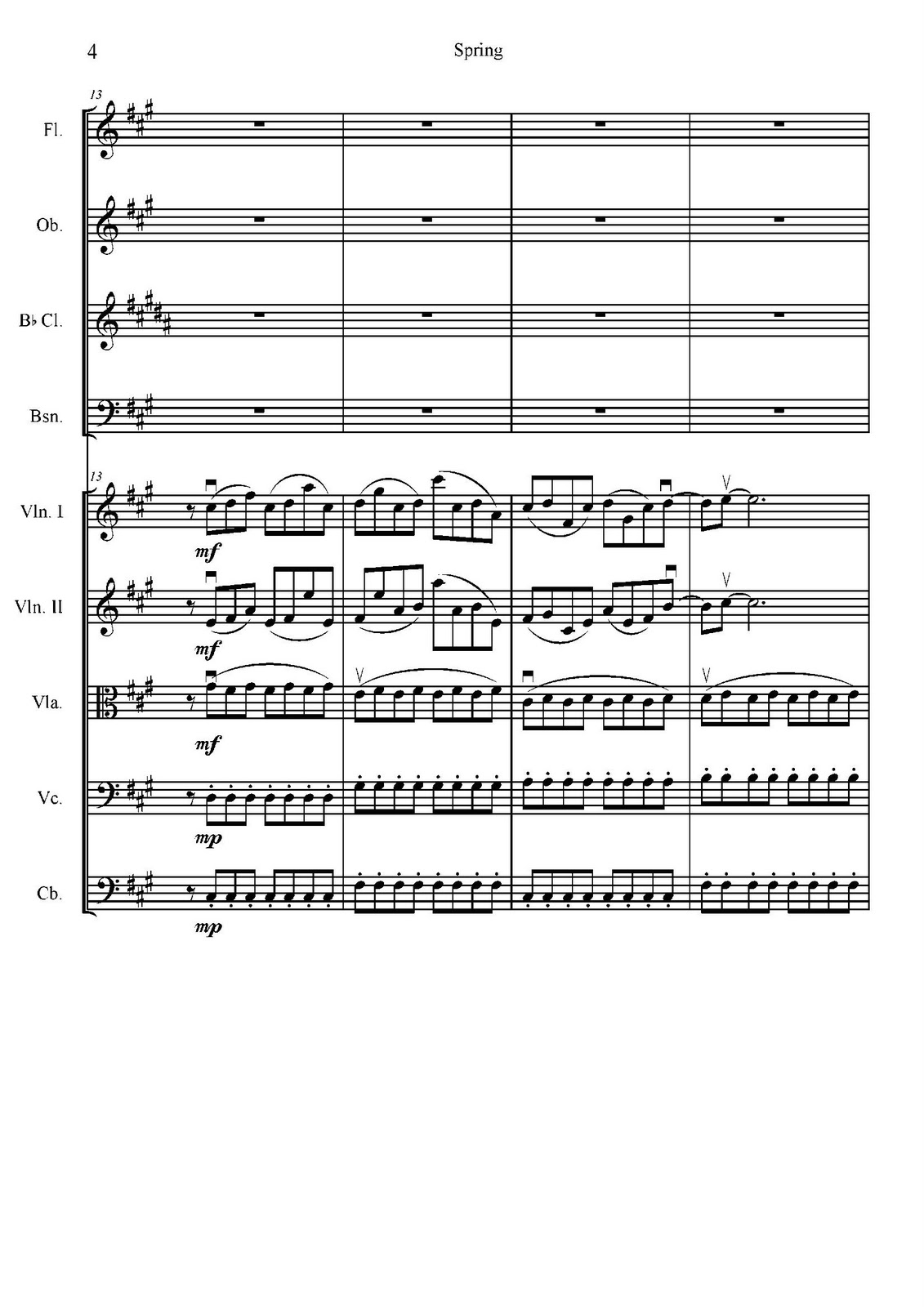
                                          Spring


                        Summer


                         Autumn